Every once in a while, the whole business of poetry starts to wear on me: the worry about publication, the worry about if it's worthwhile, the conflict between wanting to create and wanting to "matter" as a poet. But then I find a moment of exhortation like this one and all of that falls away leaving the desire to create, to speak of this world, as my essential desire.
Doubt not, O Poet, but persist. Say "It is in me, and shall out." Stand there, balked and dumb, stuttering and stammering, hissed and hooted, stand and strive, until at last rage draw out of then that dream-power which every night shows thee is thine own; a power transcending all limit and privacy, and by virtue of which a man is the conductor of the whole river of electricity.
--Ralph Waldo Emerson


Fragment
What the River’s Wife Feels
by Amy Unsworth
Under her feet, the endless mud
the shifting of pebbles, the twig-
half-decayed. The lips of minnows
against her bare calves, the wending
body of a snake, the turtle’s curiosity.
In winter, her lover’s insensible skin,
in summer, his breath rising as morning
mist. Autumn, his chiding for her
steadfastness as the leaves wither
and fall upon her outstretched arms.
by Amy Unsworth
Under her feet, the endless mud
the shifting of pebbles, the twig-
half-decayed. The lips of minnows
against her bare calves, the wending
body of a snake, the turtle’s curiosity.
In winter, her lover’s insensible skin,
in summer, his breath rising as morning
mist. Autumn, his chiding for her
steadfastness as the leaves wither
and fall upon her outstretched arms.
Poetry in the Schools
As part of my son's Language Arts program, he came up with this rather impressive poem!
Black
The king of the night,
his empire rises and falls forever
in the realm of mortals.
By J.U.
Black
The king of the night,
his empire rises and falls forever
in the realm of mortals.
By J.U.
From behind the piles. . .
of books for my final project, of papers to be graded for my students, of homework that I must make sure my three sons complete, of laundry which needs to find its way into the washing machine, and of poetry which I'm writing and revising, I'm peeking out to say hello.
Spring break is on the horizon. The weather has been exceptionally beautiful. I am well but sleep deprived.
May spring come soon to where you are.
Spring break is on the horizon. The weather has been exceptionally beautiful. I am well but sleep deprived.
May spring come soon to where you are.
In & For Itself
What I learned from Kant today:
How liberating is the idea that art does not need to "do" something? It doesn't have to teach something; it doesn't have to fit some pre-conceived notion; it doesn't have to have some value as a product. We strive to create, even if what we create never achieves "beauty," we can at least be inspired by beauty to aim for the ideal. Its value does not lie in what it is used for, but rather in & for itself.
Do I believe all this? Is art in itself & for itself enough?
How liberating is the idea that art does not need to "do" something? It doesn't have to teach something; it doesn't have to fit some pre-conceived notion; it doesn't have to have some value as a product. We strive to create, even if what we create never achieves "beauty," we can at least be inspired by beauty to aim for the ideal. Its value does not lie in what it is used for, but rather in & for itself.
Do I believe all this? Is art in itself & for itself enough?
Draft
Since I can't help but be influenced by what I'm reading, here's another (Another!) Adam poem. (You'll need to click on the poem to read it. I'm still working on the technology aspects of blogging. ) This is my first draft and I'm not sure if I'll work on it further as the concept has been around the block a time or two before.
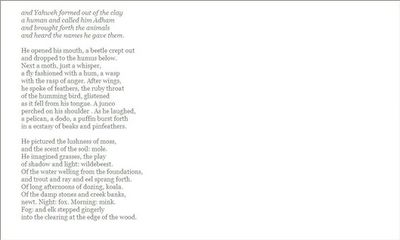
Draft:

Draft:
Why Metaphor?
Now the sources of all poetic locution are two: poverty of language and need to explain and be understood. [. . .] What Aristotle said of the individual man is therefore true of the race in general: Nihil est in intellectu quin prius fuerit in sensu. That is, the human mind does not understand anything of which it has no previous impression from the senses.
--Giambattista Vico, 1668-1744, The New Science
I understand what Vico is saying to mean that since we don't have the language to convey some experiences and because others cannot understand what they have not experienced (observed, touched, tasted, heard, smelled) that the best we can do is to use poetic language.
I like this argument for metaphor; that it can help us portray what language otherwise prevents us from conveying. Metaphor then helps us enact an experience by drawing on our previous experienced sensual data. I believe this is why blood, bone, moon and the like show up in so many poems, because these are concepts about which we all can quickly relate sensual data. It is more risky therefore (risking failure of communication) to use a metaphor with a vehicle which may be less familiar to the reader.
--Giambattista Vico, 1668-1744, The New Science
I understand what Vico is saying to mean that since we don't have the language to convey some experiences and because others cannot understand what they have not experienced (observed, touched, tasted, heard, smelled) that the best we can do is to use poetic language.
I like this argument for metaphor; that it can help us portray what language otherwise prevents us from conveying. Metaphor then helps us enact an experience by drawing on our previous experienced sensual data. I believe this is why blood, bone, moon and the like show up in so many poems, because these are concepts about which we all can quickly relate sensual data. It is more risky therefore (risking failure of communication) to use a metaphor with a vehicle which may be less familiar to the reader.
Subscribe to:
Posts (Atom)