What I learned from Kant today:
How liberating is the idea that art does not need to "do" something? It doesn't have to teach something; it doesn't have to fit some pre-conceived notion; it doesn't have to have some value as a product. We strive to create, even if what we create never achieves "beauty," we can at least be inspired by beauty to aim for the ideal. Its value does not lie in what it is used for, but rather in & for itself.
Do I believe all this? Is art in itself & for itself enough?


Draft
Since I can't help but be influenced by what I'm reading, here's another (Another!) Adam poem. (You'll need to click on the poem to read it. I'm still working on the technology aspects of blogging. ) This is my first draft and I'm not sure if I'll work on it further as the concept has been around the block a time or two before.
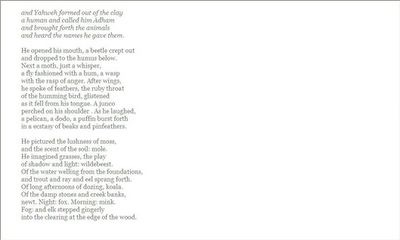
Draft:

Draft:
Why Metaphor?
Now the sources of all poetic locution are two: poverty of language and need to explain and be understood. [. . .] What Aristotle said of the individual man is therefore true of the race in general: Nihil est in intellectu quin prius fuerit in sensu. That is, the human mind does not understand anything of which it has no previous impression from the senses.
--Giambattista Vico, 1668-1744, The New Science
I understand what Vico is saying to mean that since we don't have the language to convey some experiences and because others cannot understand what they have not experienced (observed, touched, tasted, heard, smelled) that the best we can do is to use poetic language.
I like this argument for metaphor; that it can help us portray what language otherwise prevents us from conveying. Metaphor then helps us enact an experience by drawing on our previous experienced sensual data. I believe this is why blood, bone, moon and the like show up in so many poems, because these are concepts about which we all can quickly relate sensual data. It is more risky therefore (risking failure of communication) to use a metaphor with a vehicle which may be less familiar to the reader.

Eight Rules & The Bowl of Diogenes
This past week I recieved my copies of Poetry and American Poet. Each included an article on criticism. The American Poet included "Eight Rules" by Linda Gregerson and Poetry featured "The Bowl of Diogenes" by William Logan. I found each of them relevant and helpful to me as a writer who often tries my hand at criticism as well as poetry. I've often thought that thinking critically about other people's work helps me to refine and define what I'm aiming for in my own poetry.
Gregerson's article is brief, yet practical advice for the poet/ critic. Her rules include encouraging the poet/critic to write articles that are significant rather than merely thumbs up or thumbs down, she asks us to write in good faith, she invites curiosity in the world, in history, and in theory. She also suggests that we should be honest about our patronage and friends in the business. I find myself agreeing with her. She says "Both poetry and criticism are forms of thinking through, of attempting to be in the world in such a way that the world shall not be lost on us" (American Poet 16). I think perhaps the most important of her requests is that the poet/critic be well read. I believe to be well read helps us to see the greater picture, to find our niche in society, history, theory, and the world.
Logan's article is a recounting of his experiences in a long career of writing criticism, of the waxing and waning of his desire to write it, and in some ways, an argument for the complex in poetry. He also makes a lot of sense in his article, suggesting that criticism is mostly *for* the critic, and is helps the critic to pay closer attention than perhaps he or she would otherwise. He also says "for what is good about good criticism is that it imagines with the same sympathies as the poet" (Poetry 414). I like how he speaks of the complexity of poetry: "Surely we read poetry because it gives us a sense of the depths of language, meaning nudging meaning, then darting away, down to the unfathomed and muddy bottom" (414). I can imagine poetry as a minnow, reflecting a glimmer of sunlight, iridescent: a small essential beauty. And a critic wading in the shadows, searching in the muddy water, exclaiming aloud when the flash and shimmer catches her eye.
----
American Poet, Fall 2005.
Poetry, February 2006.
excerpts from "Ward 42"
In a recent conversation with A.D. , we have been discussing poetics and if it is helpful or necessary to attempt to define one's own poetics. I don't know that I'm ready to define my overall poetics, but I can talk a little bit about how I went about creating and crafting a particular poem.
The following are part of a poem titled "Ward 42." Each individual section tries to capture a particular emotion that I related to my experience in the cancer ward during chemotherapy. Thematically, I use the sea and weather throughout the poem to act as an ordering mechanism. Some of the sections seem to contradict each other, especially concerning the I.V. pump that delivers the combination of drugs that is at the same time destroying and rescuing the body.
The following are part of a poem titled "Ward 42." Each individual section tries to capture a particular emotion that I related to my experience in the cancer ward during chemotherapy. Thematically, I use the sea and weather throughout the poem to act as an ordering mechanism. Some of the sections seem to contradict each other, especially concerning the I.V. pump that delivers the combination of drugs that is at the same time destroying and rescuing the body.
excerpts from "Ward 42"
I lie on my side,
my body frames the hook of a bay,
when I ask of the future
they reply only with the rise
and fall of the diagnosis’s
changeable weather.***
The white bed is a cradle,
the swish of the pump
a mother’s heartbeat.
I awaken with my knees pulled up
my thumb in my mouth.***
In his white coat, the doctor
arrives midmorning;
like gulls, the interns stand watching.***
These are three of the eleven sections. I tried to create stanzas that were vivid, visual, and could stand alone. I tried to keep the tight focus similar to that of a haiku (although these are clearly not haiku.) I also found that I used a lot of metaphorical language, perhaps because there are few words for discussing how chemotherapy "feels" vs. the technical language for what it does.
Thanks for the conversation A.D.!
What Poetry Does
I spend quite a bit of time thinking about poetry and wondering why it has so fully captured my attention. I also ask myself if it is a worthy vocation. Will it make any difference? Does it need to make a difference? Is reading or writing or thinking about poetry a valuable way to spend one's time? I find I am often quite conflicted in my answers. I wonder why I didn't fall in love with Bio-Chemistry or Agriculture or some other field with empirical, measurable, tangible outcomes. But poetry it is.
Here is the start of a list of what I think poetry (and literature) does that is worth valuing:
1. Pays attention to the world and encourages us to pay attention as well.
2. Praises & celebrates life
3. Acts as a witness
4. Portrays different perspectives
5. Challenges us to think deeply
6. Plays with language in a way that can be entertaining and delightful
Subscribe to:
Posts (Atom)